Chapter III · Service & Slicing Mechanics
THE ART OF SERVING SLICES
Long months of cellar maturation can be muted in ten seconds by cold plating, oxidized pre-cut edges, or careless blade friction. Specialist galleries treat the final five minutes before service as an active extension of the curing craft.
I. Blade Geometry & Slicing Thickness
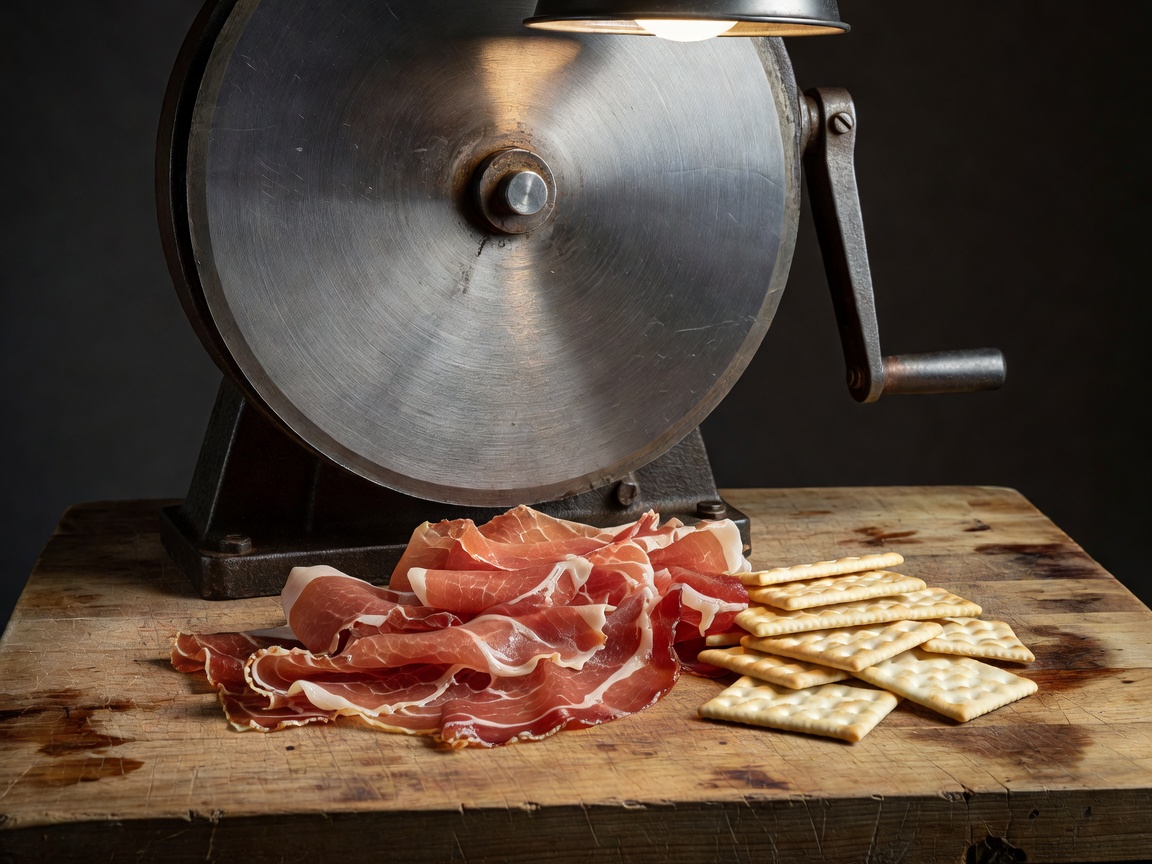
Manual Flywheel vs. Cortador KnifeTwo distinct cutting tools dominate luxury charcuterie rooms, each tailored to specific fat structures and regional conventions. Across Italian salumerie, the hand-cranked flywheel slicer—historically associated with Berkel engineering—rotates a large concave steel disc at low speed. Because the motorless blade turns gently without high-RPM friction, it avoids warming delicate fats into a smear. Tissue-thin sheets (0.5 to 0.8 millimeters) curl softly onto parchment or porcelain, maximizing surface area so volatile esters reach the nasal passage as soon as the meat touches the tongue.
Conversely, Spanish cortadores carve bone-in Jamón Ibérico strictly by hand using a long, narrow, flexible knife (cuchillo jamonero) anchored on a sturdy jamonero stand. Hand carving follows the natural curves of three distinct leg regions—the broad maza, the leaner babilla, and the intensely marbled jarrete—producing compact rectangular pieces roughly 4 centimeters square that incorporate both lean muscle and a ribbon of translucent acorn-fed fat in every bite.
Coarse-ground salumi demand slightly thicker cuts (1.5 to 2.5 millimeters) so diced backfat cubes remain intact and black peppercorns register cleanly rather than shredding out of the casing ring.
II. Four-Stage Flight Progression
Sensory Order-
STAGE 01
Lean & Subtle Air-Dried Cuts (18 °C)
Open with bresaola, dry-cured pork loin (lonzino), or young white-cured prosciutto. Low intramuscular fat leaves the palate unburdened and establishes baseline salt sensitivity before richer lipids arrive.
-
STAGE 02
Sweet Long-Aged Hind Legs (20–21 °C)
Progress to 24-month Parma, Culatello di Zibello, or Jamón Ibérico de Bellota. Warmed just until surface fat turns glossy, these cuts deliver sustained savory depth and nutty oleaginous persistence.
-
STAGE 03
Fermented & Herbal Salumi (17–19 °C)
Introduce fennel-seeded Finocchiona, garlic-cured Salame Felino, or coarse French saucisson. Lactic acidity cuts through preceding fat while whole spices lift aromatics.
-
STAGE 04
Smoked, Spiced & Pure Fat Expressions (20–22 °C)
Conclude with juniper-smoked Speck, Calabrian chili Soppressata, or paper-thin Lardo served over warm unsalted bread so high smoke or capsaicin levels do not eclipse earlier flights.
III. Restrained Accompaniments & Plating
Palate Reset ProtocolOvercrowded grazing boards—piled high with sharp aged cheddar, honey drizzles, chocolate, and garlic chutney—work against high-craft charcuterie. Strong dairy proteins and heavy sugars coat taste receptors, masking the subtle differences between a 18-month and a 36-month cure.
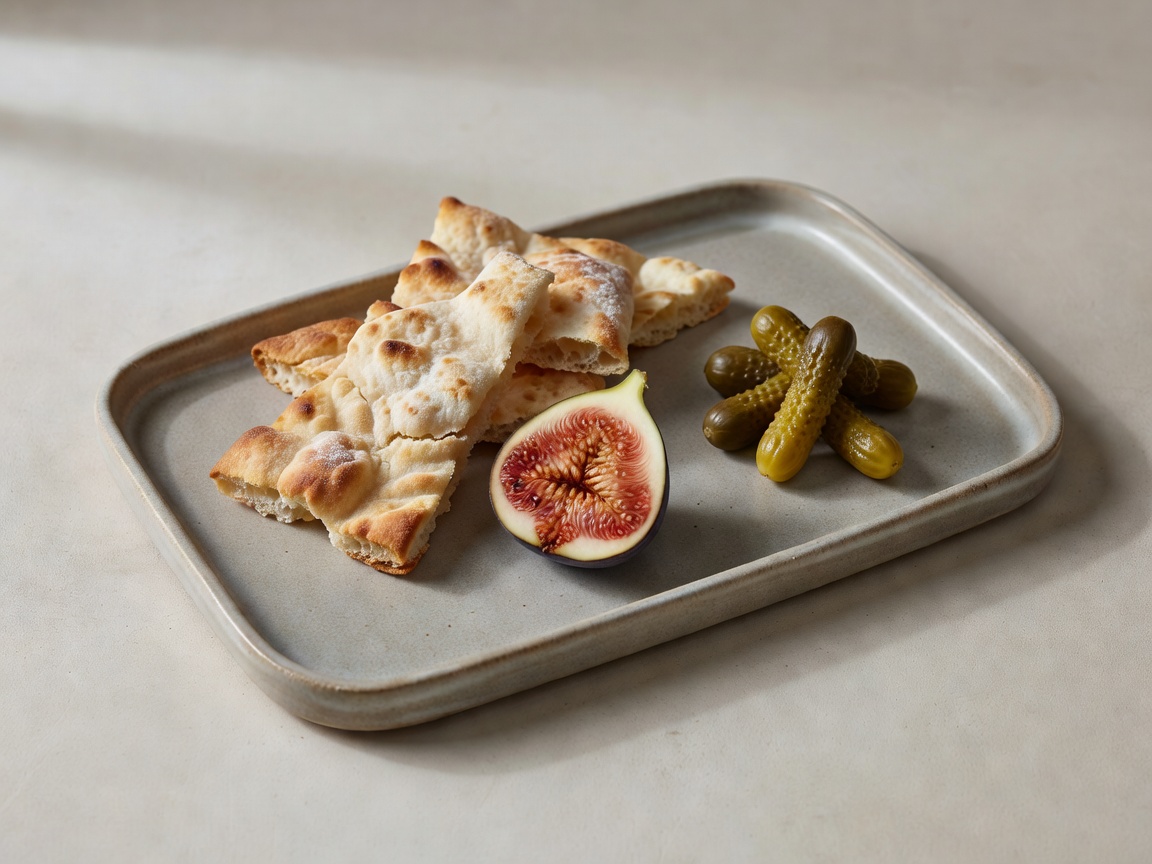
In disciplined tasting galleries, accompaniments perform three narrow mechanical functions: neutral starch absorbs lingering lipid film (Piedmontese grissini stirati, Sardinian pane carasau, or warm saltless Tuscan bread), mild acidity refreshes saliva (verjus-pickled pearl onions, cornichons, or fermented green walnuts), and crisp water-rich fruit clears salt between regions (ripe conference pear, fresh fig, or melon wedges).
Porcelain or unglazed stoneware warmed gently to hand temperature outperforms porous wood slabs or ice-cold marble, which stiffens fat before the guest lifts the second slice.