Chapter I · Preservation Architecture
CURING METHODS IN CONTEXT
Every specimen displayed inside a charcuterie gallery carries physical evidence of how moisture was withdrawn, microbial safety established, and endogenous enzymes allowed to work. Reading the method behind a cut reveals why two hams of identical breed taste radically different.
I. Whole-Muscle Dry Curing
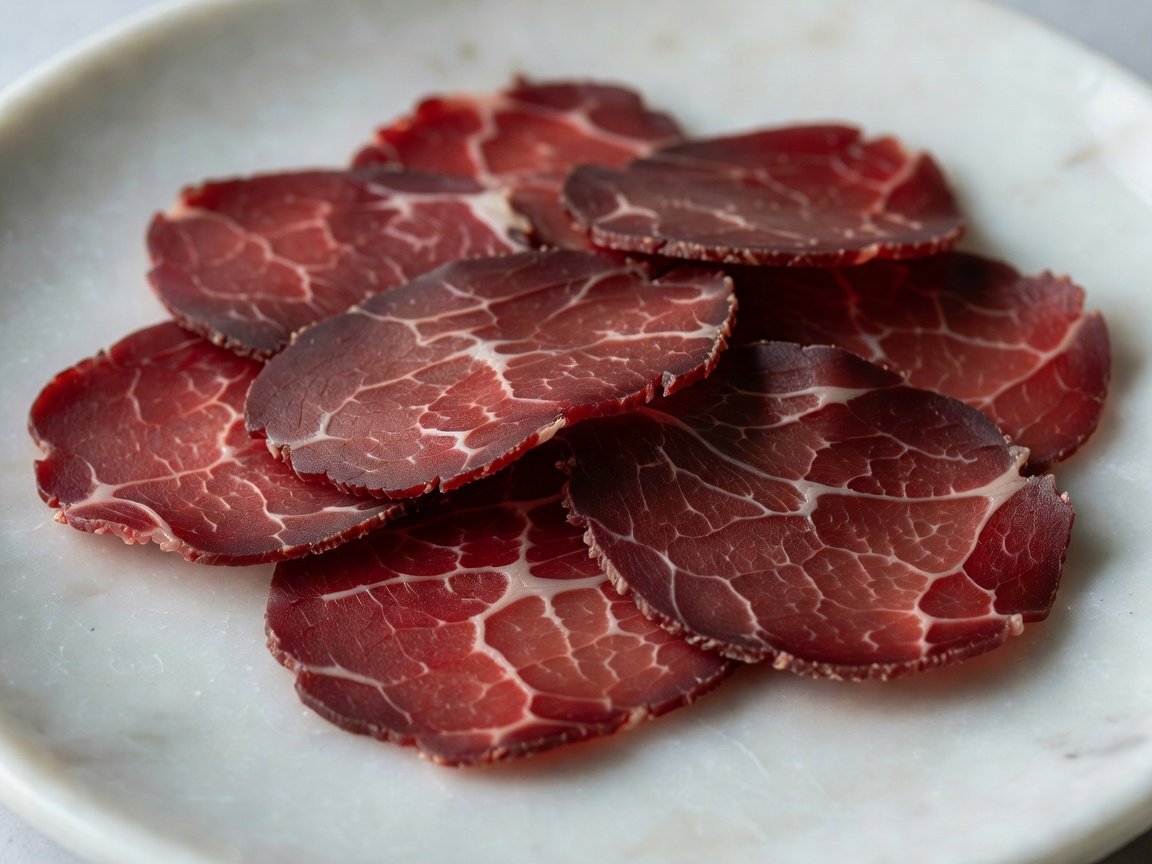
Intact Cuts · Osmotic DryingWhole-muscle dry curing begins with anatomical trim and temperature discipline. Whether preparing a bone-in hind leg (such as Prosciutto di Parma or Jamón Ibérico), a boneless pork collar (coppa), a pork belly slab (pancetta), or a beef eye of round (bresaola), the salumeria technician weighs the raw cut and applies sodium chloride—either pure sea salt or salt paired with potassium nitrate or sodium nitrite depending on regional law and cut geometry.
During the initial cold salting stage (typically 1 to 4 °C), osmotic pressure draws free cellular liquid outward while salt diffuses inward along muscle seams. After excess surface salt is brushed or washed away, the piece enters a cold resting chamber (riposo) at 2 to 5 °C for several weeks. That resting interval is essential: without it, an outer crust dries too quickly, causing "case hardening" that traps moisture near the bone and risks spoilage.
Once salinity equilibrates to roughly 4 to 5 percent in the finished weight, the cut transfers into warmer maturation rooms (12 to 18 °C, relative humidity 70 to 80 percent). Over 6 to 36 months, water activity (aw) drops below 0.88. Simultaneously, natural muscle enzymes—principally cathepsins and calpains—cleave proteins into free amino acids such as glutamic acid and tyrosine, producing deep umami and the small white crystalline flecks diners frequently mistake for salt crystals.
II. Fermented Salami & Surface Rinds
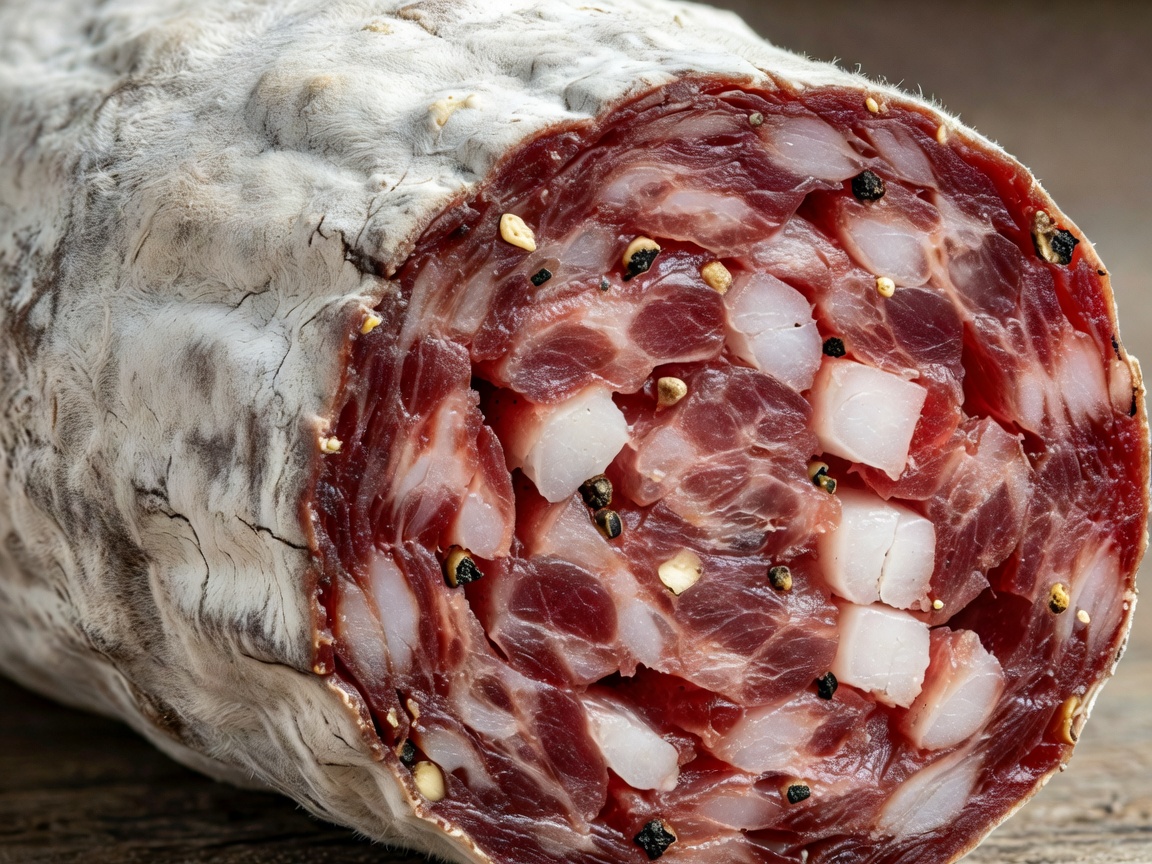
Comminuted Links · AcidificationUnlike intact whole muscles, minced charcuterie introduces oxygen and surface microbes throughout the meat mass. To secure safety and cohesive sliceability without cooking, salami makers rely on controlled lactic fermentation. Lean shoulder or ham trim is chilled near freezing so knives shear cleanly rather than smearing fat, then mixed with diced firm backfat (lardo), salt, pepper, wine, or curing salts.
Stuffed into permeable natural casings—hog middles, beef runners, or sewn caul—the links hang in a warm fermentation cabinet (18 to 26 °C) for 24 to 72 hours. Either indigenous cellar flora or selected starter cultures such as Lactobacillus sakei and Staphylococcus xylosus metabolize added sugars into lactic acid. As pH falls from roughly 5.8 toward 4.9–5.3, meat proteins coagulate into a firm gel that binds fat cubes cleanly and halts undesirable bacteria.
Following fermentation, beneficial white mold—commonly Penicillium nalgiovense—colonizes the casing during cool drying. Far from ornamental, this velvet bloom acts as a breathable skin: it buffers sudden humidity drops, shields internal lipids from light-induced rancidity, and contributes subtle mushroom and hazelnut notes through gentle lipolysis.
III. Cold Smoking, Brining & Emulsion Poaching
Comparative MatrixMountainous and northern charcuterie traditions supplement air drying with hardwood smoke or thermal processing, while urban guild traditions specialize in fine-cut poached emulsions. In a gallery tasting, recognizing which thermal or smoke intervention shaped a slice prevents comparing a cold-smoked Alto Adige Speck directly against an unsmoked Po Valley prosciutto on identical terms.
| Technique | Key Control Variable | Representative Examples | Sensory Signature on the Plate |
|---|---|---|---|
| Pure Sea-Salt Air Cure | Relative humidity 72–78%, zero smoke, no nitrite | Prosciutto di Parma DOP, San Daniele DOP | Rounded sweetness, butter-soft fat, lingering hazelnut aroma |
| Nitrate / Nitrite Dry Cure | Controlled curing salt ppm, 4–12 month cellar rest | Coppa Piacentina DOP, Salame Felino IGP | Bright ruby lean color, firm snap, savory cured-pork depth |
| Intermittent Cold Smoke | Smoke chamber below 20 °C using beech, juniper, or fir | Speck Alto Adige IGP, Schwarzwald Schinken g.g.A. | Resinous top note, darkened outer rind, peppery mountain finish |
| Cured Fat Maturation | Marble basins or seasoned wooden chests, 6+ months | Lardo di Colonnata IGP, Valle d’Aosta Arnad | Translucent ivory slice, herbal spice veil, zero stringy collagen |
| Fine Emulsion & Dry Bake | Ice-chilled bowl chopping, 70 °C core target | Mortadella Bologna IGP, Lyon Rosette variants | Silky uniform matrix, sweet toasted spice, delicate fat dispersion |
IV. Field Notes for Tasting Inspection
Expandable ObservationsWhy do aged hams show pinhead white crystals along muscle seams?
Those small matte-white specks are precipitated tyrosine—an amino acid released as proteins break down over 18 months or longer of enzymatic maturation. They crunch lightly between the teeth without sharp saltiness and serve as a reliable physical indicator of extended aging rather than surface dehydration.
What separates artisanal lardo from raw unaged pork fat?
Raw backfat feels waxy and flat on the tongue. True cured lardo—aged in Carrara marble troughs rubbed with garlic, rosemary, and sea salt—undergoes slow enzymatic softening and lipid transformation so a 1-millimeter ribbon liquefies cleanly at body temperature.
How can diners spot case hardening on a charcuterie board?
Look at cross-sections of salami or coppa: a dark, brittle, glassy outer ring surrounding a pale, overly soft core signals that drying room humidity dropped too rapidly early in production, sealing moisture inside before equilibrium occurred.